


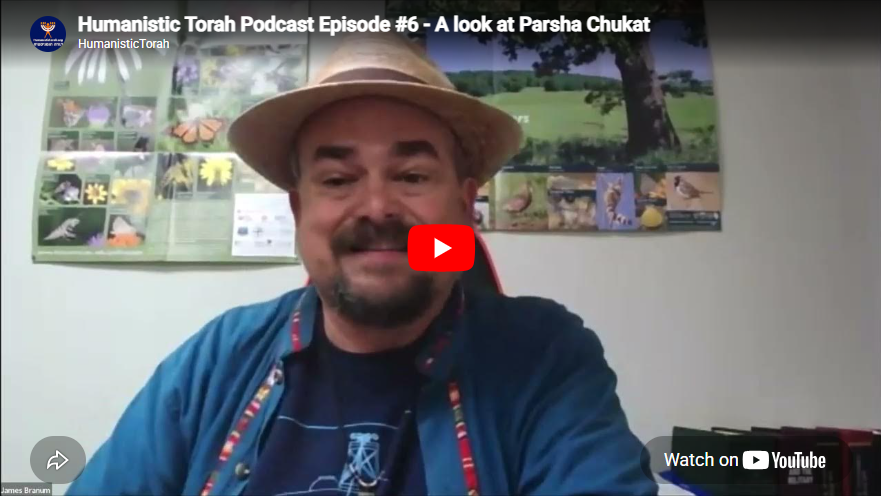
Humanistic Torah Podcast – Episode #6 – Parsha Chukat
Hosted by James M. Branum
The following is a working transcript of the program, but please note that I may have made slight change of wording on the fly:
Welcome to the Humanistic Torah podcast, hosted by James M. Branum.
This is episode #6, recorded on June 18, 2026.
This program is brought to you by Shalom V’Tzedek, a program of Unbound Humanistic Jewish learning.
Before I get into the heart of today’s episode, I do want to share a couple of announcements.
First, this will be the first episode that I’m going to also sharing in video form as well as in audio. I’m doing this mostly to try to reach a new audience via Youtube, and social media.
Secondly, I now am running a fundraiser via the Ko-Fi crowd sourced funding program, so if you could like to help me to put our more quality content, please go to https://ko-fi.com/jmbranum and either give a one-time donation or pledge to give on a monthly basis.
Speaking of those donors, I want to give a quick shout to those who gave in the last month including Elliott Ratzman, Paul Walker, Bill & Ty Vaughan, and also our newest monthly supporter Gabrielle! Thank you all so much!
So let’s jump in and explore some Unbound Humanistic Torah—-
In this episode, I’m going to share a D’var Torah message that I’m going to be sharing at the upcoming Shabbat gathering of the Spinoza Havurah, an online Humanistic Jewish community.
The text I’ll be exploring is from Parshah Chukat, but more specifically from Numbers 19:1-13.
(READ Numbers 19:1-13)
To our modern ears, this text sounds strange and weird, but also more than bit irrelevant. But . . . this text can make more sense if we use our power of imagination to do some time travel to the time that that this text came into its present form.
Tradition says that Moses wrote all but the final verses of the Five Books of The Torah, but modern Biblical scholarship says that the text as know it today likely came into being during the aftermath of the Babylonian captivity. This was a time of both mourning, but also creativity, when Jews had to reinvent our tradition to deal with the destruction of the Jerusalem Temple. One of the key elements of this reinvention was writing, so that previous disparate traditions (both oral and written) came to be centralized. We don’t know exactly how this happened, but the best arguments are that this happened around 450-350 BCE in the cosmopolitan Persian empire, where the stories and practices of not only the Persians, but also Greeks, Babylonians and many others were familiar to Jewish people.
During this time period, many of the rituals and practices depicted in the Torah were common modalities, practices that almost everyone did —including animal sacrifices, fasting, and cleansing rituals. These practices would not have been seen as weird or unusual, but rather completely normal. Judaism (as depicted in these books) didn’t invent these traditions, but rather gave them new meanings and understandings — ones that I think were often more humane than those of their neighbors.
It is for this reason that I want us to shift our attention away from the minutiae of the ritual, and instead towards the purposes and meanings behind the rituals.
Numbers 19 tells about the method of creating special ashes that were used in cleansing rituals. A red (or possibly redish brown) heifer was killed and its carcass was burnt. The ashes were then gathered and kept for future rituals. These ashes may have been used in other contexts, but we know for sure they were used to purify those who had been present during a death or who had encountered dead body, but also were used as part of the purification rituals after war, both of the booty taken but also of the warriors themselves (which we can read about in Numbers 31).
In both cases, I would argue that these purification rituals are about healing from trauma. The rituals involved a time of separation from the community which provided a kind of liminal (or in-between space), followed by a ritual of washing using this specially-prepared ash water.
Before I go on, I should mention that these kinds of rituals are also present in other world religions and traditions, not only in the other traditions of ancient Southwest Asia, but also in other places — most notably in Indigenous American traditions, which often have very similar traditions of separation and then washing after certain kinds of traumatic experiences.
And this purpose is where I find the modern relevance in this text for us today. All of us will go through trauma in our lives, but thankfully we can follow the example of our ancestors. While we likely won’t be sacrificing any animals, we can create liminal spaces and rituals after we go through trauma, which can help to bring healing.
Some of you may already know this, but my day job is working as a defense attorney in the US military legal system over the last 20 years. I’ve worked with many combat veterans who struggle with issues of PTSD and related issues. Thanks to their testimonies, I’ve learned that the hardest part of returning from war for many is reintegration back to civilian life— and I think there are elements of modern warfare that have made this problem more difficult, namely the way we bring our troops home.
As discussed by psychologist and author Jonathan Shay (and others) — during World War 2, troops coming home traveled together as units by boat. The crossing of the ocean from either the European or Pacific theater took several weeks by slow-moving troop transport ships, which served as a kind of liminal space – where the troops were no longer “in the war” but neither were they “home” yet. But in later wars (including Korea, Vietnam, Iraq — both times, and Afghanistan), troops more often came home by airflight, sometimes with their units but also often not. There was little if any transitional time with one’s comrades, and hence the jolt of everyday civilian life was pretty hard.
I must wonder if a driving force behind the increase in PTSD rates among veterans might in part be tied to this lack of appropriate secular rituals of reintegration? And I have to wonder, if this ancient text might give us some confirmation of the necessity of having these rituals, not only for the combat veterans among us, but for all who deal with trauma?
So as we move into our discussion time, I would like to leave you with these questions:
- What might liminal/in-between space after trauma look like for us today?
- What ritual might be satisfying as a mark of concluding post-trauma liminal space?
- Is it important to us that these rituals be specifically Jewish in nature?
- How can we help to make it easier for others to engage in healing practices?
If you would like to be part of a live discussion of this text, please join the Spinoza Havurah’s upcoming Shabbat service on June 20th at 9 am central (details can be found in the shownotes), or please share your thoughts on our discord server or on the facebook page for HumanisticTorah.org.
Finally, if you have any comments, questions, feedback, etc, please email me at shalomvtzedek@pronton.me.|
Until next time, Shalom!
Podcast: Play in new window | Download